
Climate change, also known as global warming, is largely accepted by climate scientists, though has been targeted with denial and misinformation. In this blog post I will explain the origins of the controversy, how persuasion tactics were used, and how a widely accepted idea still faces skepticism today.
Put simply, global warming is the rise of the Earth’s average surface temperature due to human activities that release gases such as carbon dioxide and methane. These gases lead to the “warming” of the globe and are backed by decades of research (NASA). The controversy surrounding global warming is less involved within the scientific aspect but more-so about how the public, government officials, politicians, etc. interpret the evidence. The center of the controversy is set on questioning how severe the impact of these changes will be, what actions can be used to stop/slow global warming, and most commonly, how responsible are humans for global warming. On one side of this controversy, climate scientists overwhelmingly agree on the human impact on global warming (IPCC), while opponents have expressed their doubt on these facts, arguing that the urgency is minimal and that proposed solutions are too costly or restrictive.
The origin of the global warming controversy dates back as early as the 1950s and 1960s, when some oil companies such as Exxon realized that the burning of fossil fuels could impact the global climate (Harvard). Rather than alerting the public, many massive corporations funded efforts to create uncertainty regarding their potential impact on global warming and force delays on regulations. Later on in the 1980s and 1990s, groups that were associated with fossil fuels formed partnerships with conservative think tanks to organize a structured denial movement. Statements such as the 1995 Leipzig Declaration were presented as scientific opposition to climate change, though they were backed and even coordinated by groups that were tied to the industry (Leipzig Declaration). In addition to these documents, efforts from other organizations against global warming created doubt on the topic during important times when international policy regarding climate change was being discussed and debated.
Additionally, persuasion tactics alongside propaganda played a massive role in this controversy. A common strategy that was used to doubt global warming was to exaggerate scientific uncertainty within the topic. Campaigns highlighted the small caveats within the scientific models to amplify the doubts of the scientific research as a whole, implying that the field of climate science in its entirety was unreliable. Another popular strategy was the use of “fake experts,” scientists with credentials in unrelated fields or public speakers without credentials entirely that were presented as credible sources that were used to challenge mainstream research. These strategies were effective in making the debate appear to be more divided then it actually was. Additional tricks were used such as cherry-picking data, in which graphs showing only short cooling periods were used to further doubt the real scientific data.
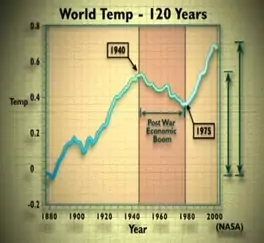
Above is an example of a misleading graph from “The Great Global Warming Swindle,” a 2007 documentary denying the scientific consensus about the reality and causes of climate change. Later on, “It soon became apparent that this is not a NASA graph. Durkin admitted that it had in fact been taken from a pamphlet created by a group of campaigners who opposed policies in the United States to cut carbon dioxide emissions from the burning of fossil fuels.” (The London School of Economics and Political Science.)
Today, the scientific debate surrounding global warming and climate change is effectively resolved. Nearly all climate scientists have come to an agreement that human activity is the dominant driver of global warming. Additionally, public opinion has seen a significant change, though not entirely or evenly. Many European, Asian, and other countries have shown a broad acceptance of climate change and have established it as a real and urgent problem. Acceptance in the United States, however, still remains deeply polarized, with political influence influencing beliefs rather than scientific evidence. Fossil fuel companies have even adapted their messages, rather than expressing their outright denial of human impact, they now often emphasize a delay. As one of the ways the “What is Propaganda?” article from the learning materials defines propaganda, “Propaganda is a form of communication aimed towards influencing the attitude of a population toward some cause or position. -Wikipedia, entry on propaganda, 2008.” This shift in belief or attitude to the controversy provides a clear example on how propaganda evolves, with the narrative starting as “global warming isn’t real” then becoming “it might be real, but the solutions are too expensive.”
In conclusion, the global warming controversy proves to be a clear example of how propaganda and persuasion tactics can shape the public perception on topics, even when the topic is backed by clear, scientific evidence. This controversy highlights how effective these strategies can truly be, especially when used effectively by massive corporations to shift public opinion. Altogether, global warming proves to be not only a scientific controversy, but also a battle of persuasion and manipulation of the public, proving that successful tactics can change or delay course of action even when there is an overwhelming amount of evidence against it.